
Seeing an unfamiliar number on a blood test can be worrying, especially when it is associated with cancer. If your report includes a CEA result, you may be wondering whether it is normal, mildly elevated, or something that requires further investigation. The CEA blood test normal range provides a useful starting point for understanding your result, but CEA levels cannot be interpreted in isolation. Your smoking status, medical history, reason for testing, and changes in CEA over time can all affect what the result means.
In this guide, we explain the CEA blood test normal range, what different levels may mean, why smokers can have higher results, and how doctors use CEA testing to monitor certain cancers.
What Is the CEA Blood Test?
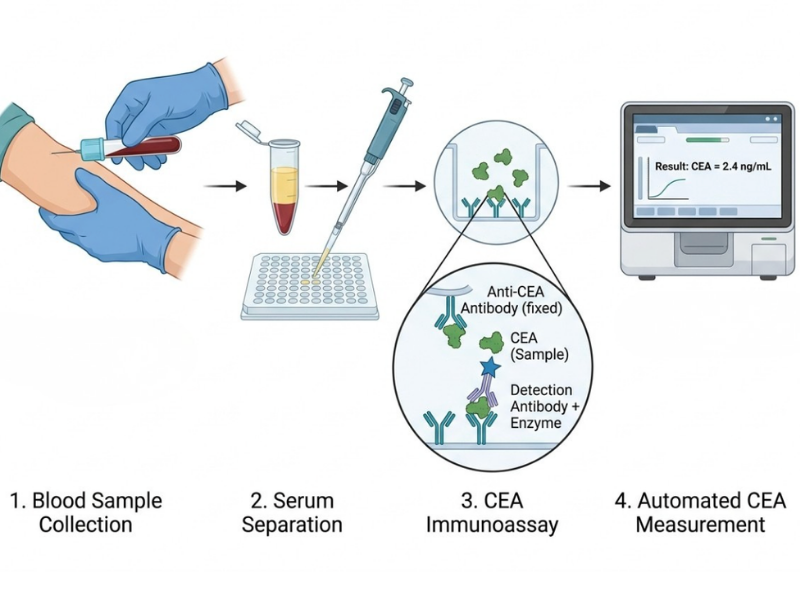
CEA, or carcinoembryonic antigen, is a protein that is normally present at very low levels in adults. Higher amounts can be produced by some cancer cells and by certain non-cancerous conditions. A CEA blood test measures the amount of this substance in your blood. It is classified as a tumor marker, which means it can provide information about certain cancers and how they may be responding to treatment.
However, CEA is not a cancer screening test for the general population. A CEA blood test normal range result does not completely rule out cancer, and an elevated result does not confirm that cancer is present. Doctors interpret CEA alongside symptoms, physical examination, imaging, biopsy results, and other laboratory tests. CEA testing may be used to:
- Establish a baseline before cancer treatment
- Monitor a person's response to treatment
- Check for changes after treatment
- Help monitor certain cancers for possible recurrence
The reason your doctor ordered the test is therefore important when interpreting your result.
CEA Normal Range in ng/mL
The CEA blood test normal range can vary between laboratories because different testing methods and analysers may be used. Your laboratory report should always be checked first because its reference interval may differ from another lab's. A commonly used reference range is approximately 0–2.5 ng/mL for non-smokers and up to 5 ng/mL for smokers.
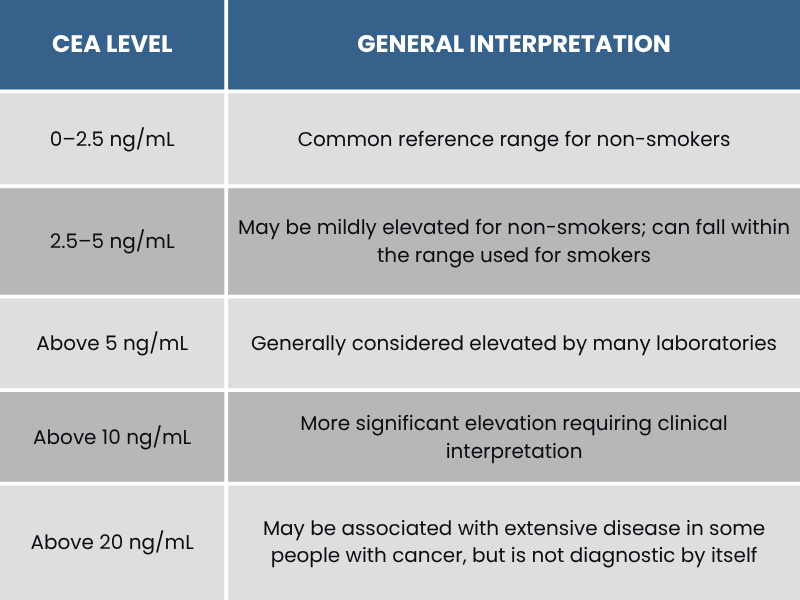
These numbers are general guides rather than universal diagnostic cutoffs. The CEA normal range ng/ml shown on your own laboratory report is the most relevant reference for interpreting your individual result. A result outside the reference range does not necessarily indicate a serious problem. Doctors consider the degree of elevation, your health history, and whether the result changes when repeated.
CEA Levels: Smokers vs Non-Smokers
Smoking is one of the most important factors to consider when interpreting CEA. People who smoke can naturally have higher CEA concentrations than non-smokers.
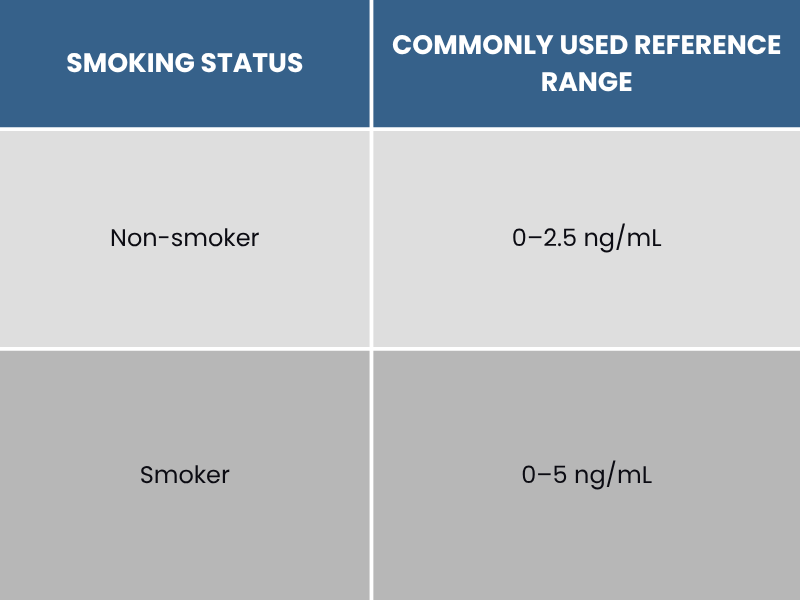
This means a CEA level that appears slightly high for a non-smoker may not have the same significance in a person who smokes. If you regularly have CEA testing, tell your healthcare provider whether you smoke. It can help them interpret the result appropriately. If possible, repeat testing using the same laboratory and method can also make changes over time easier to compare.
What Does a High CEA Level Mean?
The CEA blood test high meaning depends on the individual rather than a single number. A high result can occur with certain cancers, but it can also occur because of smoking, inflammation, infection, or other medical conditions. CEA can be elevated in cancers such as colorectal, pancreatic, lung, breast, liver, and some other cancers. However, not every cancer produces CEA, and some people with cancer have normal CEA levels.
This is why the CEA blood test normal range should be used as a reference point rather than a definitive test for cancer. Your doctor may look at:
- Your exact CEA level
- Whether you smoke
- Previous CEA results
- Your symptoms
- Your cancer history, if applicable
- Other blood tests
- Imaging studies
- Biopsy results when necessary
A mildly elevated CEA may therefore require a very different response from a persistently rising or substantially elevated level in someone already being treated for cancer.
Benign (Non-Cancer) Causes of a Raised CEA
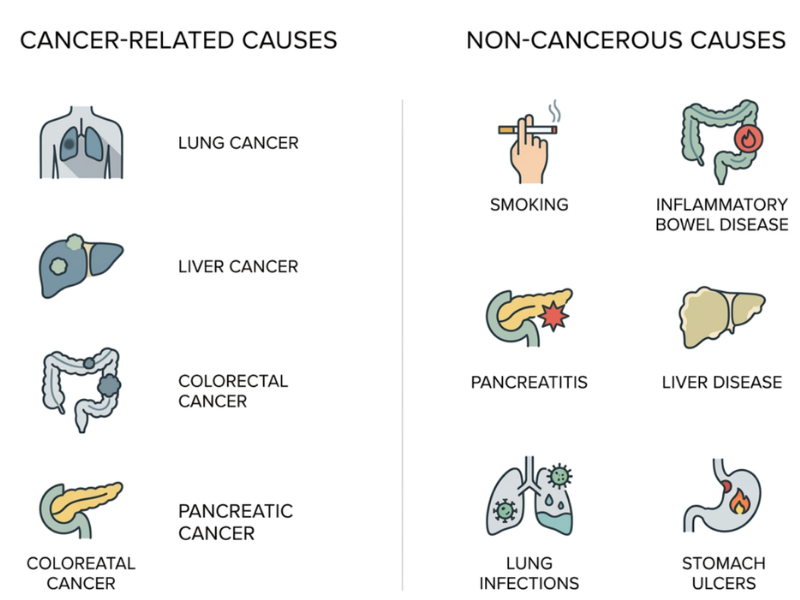
An elevated CEA does not automatically indicate cancer. Several benign conditions can increase CEA levels. Possible non-cancerous causes include:
- Smoking
- Inflammatory bowel disease, including Crohn's disease and ulcerative colitis
- Pancreatitis
- Liver disease or cirrhosis
- Gallbladder inflammation
- Lung infections
- Stomach ulcers
- Other inflammatory conditions
Because these conditions can affect CEA, your doctor may investigate other possible causes before drawing conclusions about an elevated result. This is particularly important when the increase is mild and there are no other findings suggesting cancer.
How CEA Is Used to Monitor Cancer
CEA is often more useful for monitoring certain cancers than for initially diagnosing them. For example, if a person with colorectal cancer has an elevated CEA before treatment, doctors may measure it repeatedly during and after treatment. If the level falls, it may indicate that the cancer is responding to treatment. If it later begins to rise consistently, further investigation may be considered. A single result is therefore less informative than a series of results.
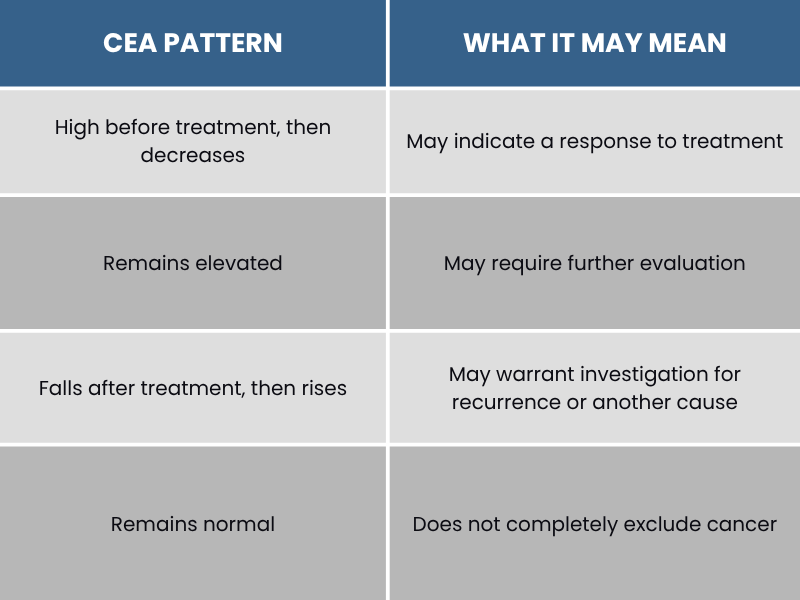
The CEA blood test normal range can help establish whether a result is outside the expected laboratory reference interval, but the trend over time is often more useful when CEA is being used for cancer monitoring.
What Is a Dangerous CEA Level?
There is no single CEA value that is considered dangerous for every person. A result that is slightly above the laboratory reference range may have a completely different significance from a substantially elevated result in someone with a known CEA-producing cancer. Levels above 10 ng/mL may be associated with more extensive disease in people who have cancer, while levels above 20 ng/mL can be associated with metastatic disease. However, these values do not diagnose cancer or prove that cancer has spread. The CEA blood test normal range should therefore not be treated as a simple boundary between "safe" and "dangerous." If your result is high, your doctor may recommend repeating the test, reviewing possible non-cancerous causes, or ordering additional investigations depending on your situation.
Do not assume the worst based on the number alone. CEA is a supporting test, not a stand-alone diagnosis.
Other Tests Ordered Alongside CEA
Because CEA cannot determine whether cancer is present by itself, doctors may use other tests to investigate an abnormal result. Depending on your symptoms and medical history, these may include:
Complete Blood Count:
A CBC can provide information about red blood cells, white blood cells, and platelets. It may help identify anemia or other abnormalities that require further investigation.
Liver Function Tests:
Liver tests may be useful because liver disease can sometimes cause CEA levels to increase.
Imaging Tests:
CT scans, MRI scans, ultrasound, or PET scans may be recommended when doctors need to look for abnormalities in specific parts of the body.
Colonoscopy:
If colorectal disease is suspected or colorectal cancer screening is appropriate for your age and risk level, a colonoscopy may be recommended.
Biopsy:
If imaging identifies a suspicious area, a biopsy may be needed to examine tissue under a microscope and determine whether cancer is present.
The tests you need depend on why your CEA was ordered. A CEA result should always be interpreted in the context of your complete clinical picture.

Understanding Your CEA Blood Test Results
The CEA blood test normal range gives you a useful starting point for understanding your laboratory report, but it does not tell the whole story. An elevated result does not automatically mean cancer. Smoking, inflammatory bowel disease, infections, liver conditions, and other non-cancerous problems can also increase CEA. If you already have cancer, CEA can be particularly useful for monitoring changes over time. A rising or falling pattern may provide information about how treatment is working or whether further investigation is needed. Most importantly, don't try to diagnose yourself from one blood test.
Explore MySimpleReport and take control of your health records.