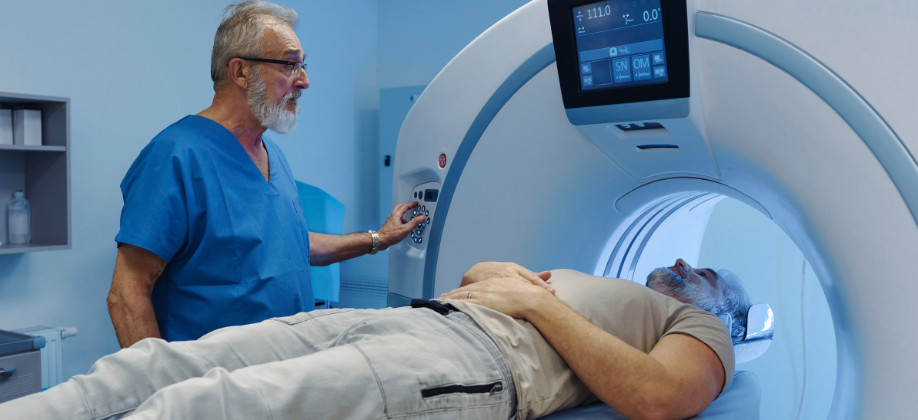
A CT scan report translates detailed medical images into written information that patients and healthcare professionals can understand. While the terminology can seem complicated, most reports follow a recognizable structure. Understanding sections such as Findings, Impression, Technique, and Comparison can make a report much easier to follow. The two sections patients usually want to understand most are the Findings and Impression. This guide explains how to read a CT scan report, what common terms mean, how to understand the Impression, and how to approach recommendations for follow-up without trying to diagnose yourself from individual phrases.
What Is A CT Scan Report?
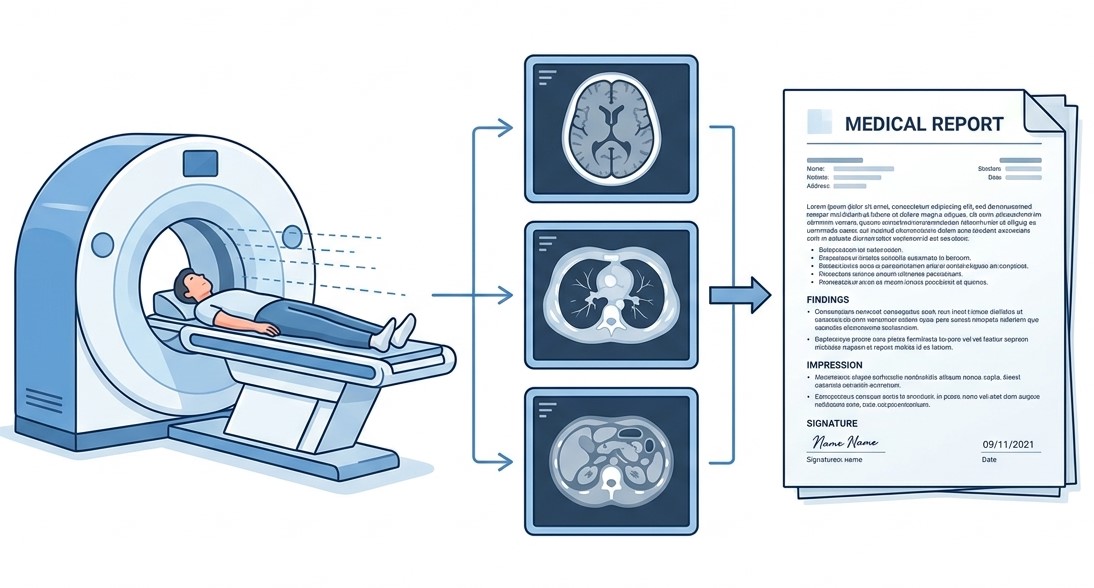
A CT scan report is the written interpretation of images produced by computed tomography (CT). During the examination, multiple X-ray images are combined to create detailed cross-sectional views of the body. A radiologist reviews these images and documents relevant observations, including normal structures, abnormalities, measurements, and changes compared with previous examinations when available. The report is an important part of the diagnostic process, but it is not necessarily a complete diagnosis by itself. Your symptoms, medical history, physical examination, laboratory results, and previous imaging may all affect how the findings are understood.
What Are The Main Sections Of A CT Report?
Although report formats vary, a CT scan report usually contains several sections that serve different purposes.
Clinical History Or Indication
This section explains why the examination was requested. It may mention abdominal pain, an injury, persistent headaches, suspected infection, or follow-up of a known condition. The clinical indication gives context to the imaging assessment and helps explain why particular structures or abnormalities may receive attention.
Technique
The Technique section describes how the examination was performed. It may mention the body region examined, whether contrast material was used, and the type or phases of imaging obtained. This is primarily technical information and usually requires little interpretation by patients.
Comparison
A report may identify previous imaging used for comparison. Phrases such as "stable," "unchanged," or "new since prior examination" describe whether a finding has changed over time. Comparison can be particularly useful when monitoring a previously identified abnormality.
Findings And Impression
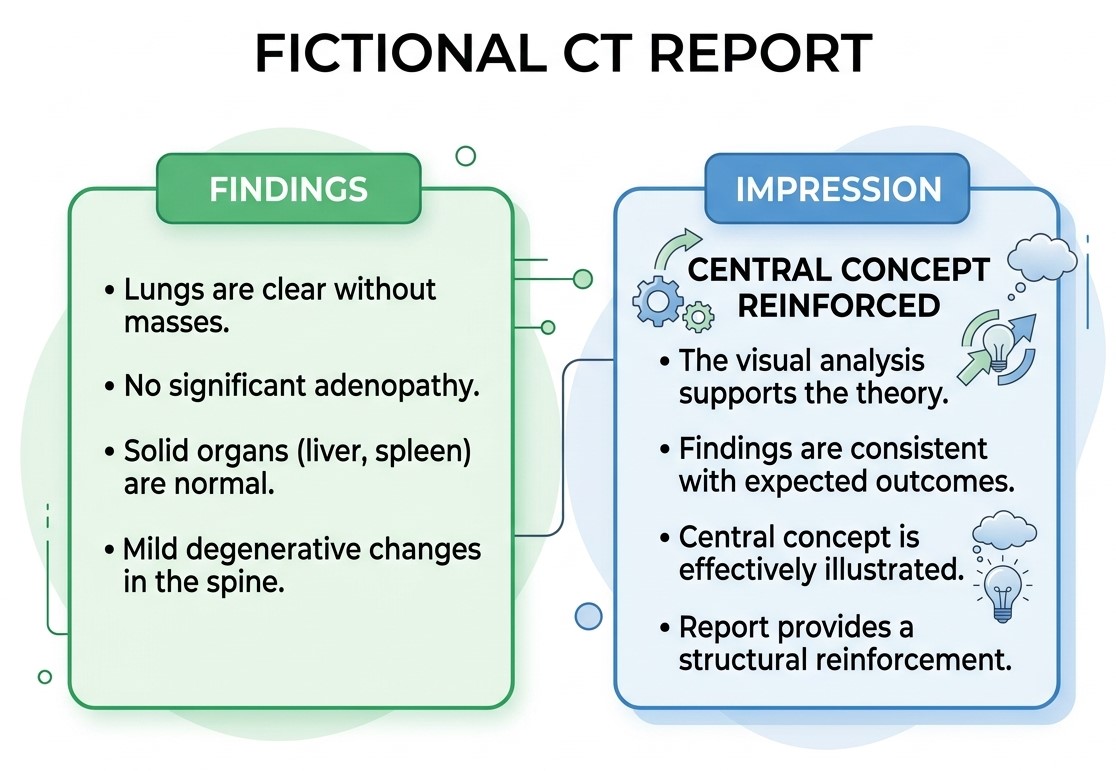
The Findings section provides detailed observations from the images, while the Impression summarizes the observations considered most clinically important. Knowing the purpose of these two sections makes the rest of the report much easier to understand.
How To Read The Findings Section
The Findings section is usually the most detailed part of a CT scan report. It describes what was observed in the anatomical structures examined, often following a systematic order. For example, an abdominal examination may describe the liver, gallbladder, pancreas, spleen, kidneys, bowel, lymph nodes, blood vessels, and bones. A chest examination may discuss the lungs, airways, heart, pleura, lymph nodes, and visible bones.
Not every statement represents a problem. Radiologists commonly document normal structures to show that they were reviewed and that no significant abnormality was identified. You may see phrases such as:
- "Normal appearance"
- "No focal abnormality"
- "Unremarkable"
- "No evidence of..."
- "Mild enlargement"
- "Small lesion"
- "No significant change"
An unfamiliar term should not be interpreted on its own. Its meaning depends on where the finding occurs, its appearance and size, the reason for the examination, and the other information in the report.
What Does The Impression Mean?
The Impression is generally the most concise and clinically focused part of a CT scan report. It brings together the observations that the radiologist considers most important. For example, the Findings may contain several paragraphs describing different structures, while the Impression may summarize only one or two significant observations. It may also indicate whether a finding is new, stable, or potentially related to the reason for the examination.
Common wording can include:
- "No acute abnormality identified"
- "Findings are consistent with..."
- "Findings suggest..."
- "Clinical correlation recommended"
- "Follow-up imaging recommended"
- "Stable compared with prior examination"
These statements should not automatically be treated as definitive diagnoses. Wording such as "suggestive of" or "consistent with" describes an imaging interpretation that may need to be considered alongside symptoms, examination findings, medical history, or additional tests.
Findings Vs Impression: What's The Difference?
Understanding findings vs impression is one of the simplest ways to understand an imaging report. The Findings section answers: What was observed? The Impression answers: What are the most important conclusions from those observations?
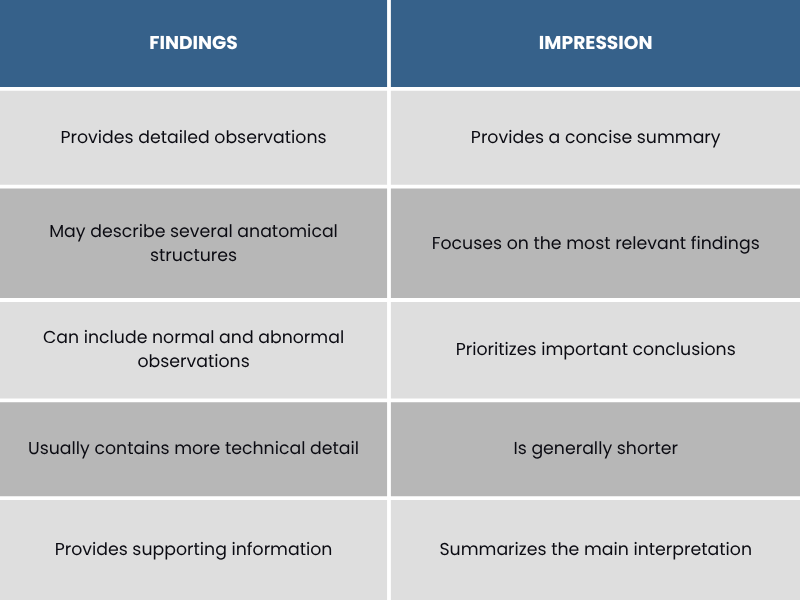
The two sections work together. The Impression gives you the overall message, while the Findings provide the details behind that message.
Common Terms You May See In A CT Report
Medical terminology can make an imaging report seem more alarming than it actually is. Understanding a few common terms can provide useful context.
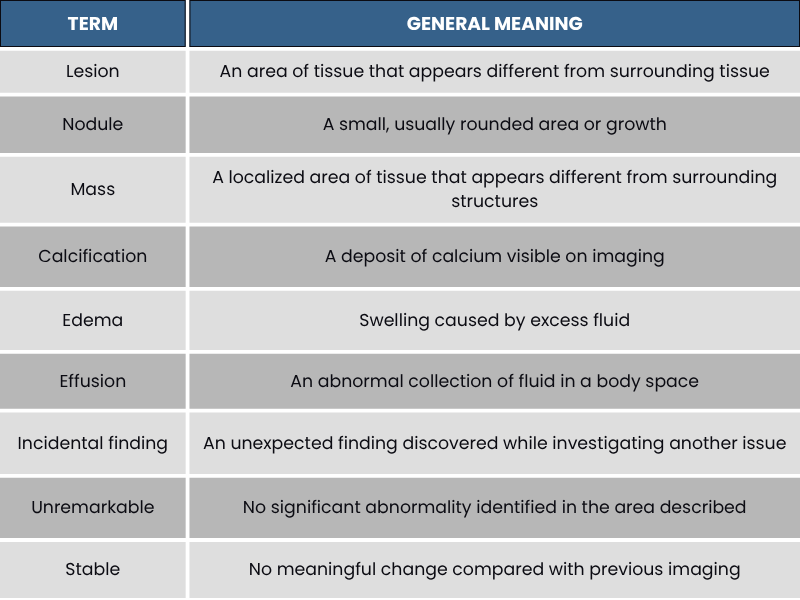
These are general descriptions, not diagnoses. For example, the significance of a lesion depends on factors such as its location, size, appearance, and the patient's clinical history.
What Does "No Acute Abnormality" Mean?
A CT scan report may state "no acute abnormality." Generally, this means that the examination did not identify an obvious urgent or newly developed abnormality in the structures examined. It does not necessarily mean that every possible medical condition has been ruled out. CT has specific capabilities and limitations, and some conditions may require another type of imaging, laboratory testing, or clinical assessment.
Similarly, "unremarkable" generally indicates that no significant abnormality was identified in the structure being described. These phrases should be understood in the context of the complete report rather than treated as guarantees that no health problem exists.
What Does An Abnormal CT Finding Mean?
An abnormal finding does not automatically mean a serious disease. Imaging can identify minor changes, incidental findings, abnormalities that need monitoring, or findings that require additional investigation. A report may recommend further evaluation when an imaging finding needs to be considered alongside symptoms, physical examination, laboratory results, or previous studies. This is often described as clinical correlation.
The wording surrounding an abnormality is important. A finding described as incidental or stable may have a different significance from one that prompts an urgent recommendation. This is why interpreting one isolated phrase can be misleading. If an abnormality is unfamiliar, focus on the complete Impression and discuss the result with the healthcare professional who ordered the examination.
What Does A Follow-Up Recommendation Mean?
A CT scan report may recommend another examination or test when additional information would help clarify a finding. Depending on the situation, the recommendation may include:
- Repeat CT imaging
- MRI
- Ultrasound
- Laboratory testing
- Specialist assessment
- Comparison with previous imaging
A recommendation for follow-up does not necessarily mean that a diagnosis has already been established. Sometimes the purpose is simply to monitor a finding over time or obtain a more detailed view. Patients can ask their healthcare provider what finding prompted the recommendation, what test is being suggested, when it should be completed, and what question the additional examination is intended to answer.
How To Read Your Report Step By Step
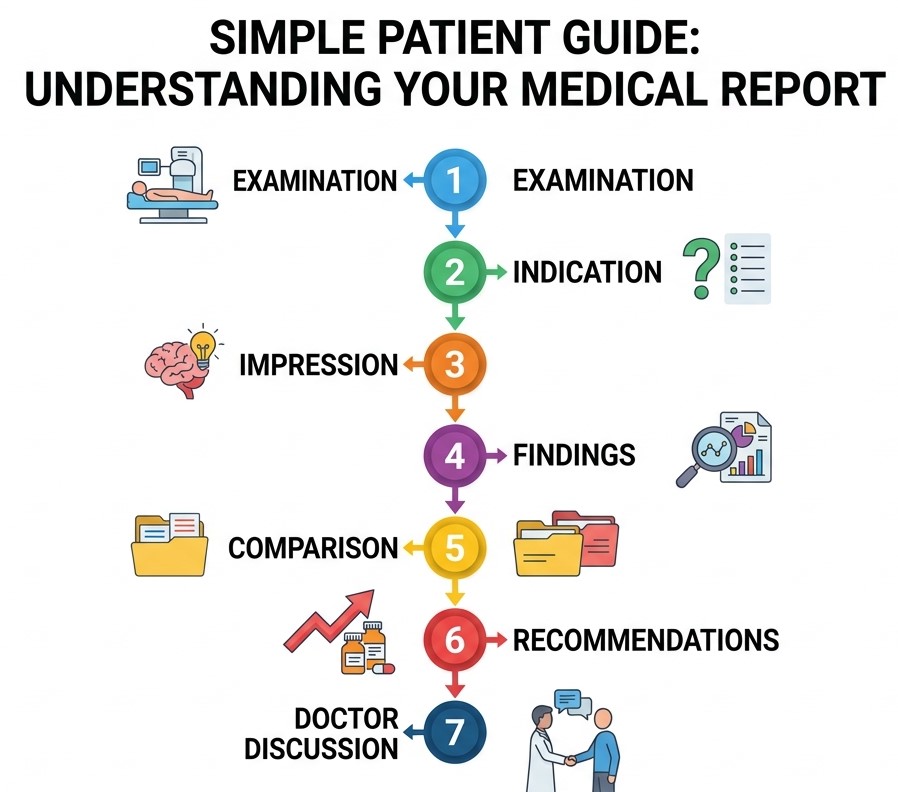
When reviewing a CT scan report, you do not need to understand every technical term immediately. Instead, work through it in a logical order.
1. Check the examination.
Confirm which body part was examined and whether contrast was used.
2. Read the clinical indication.
Understand why the scan was performed.
3. Start with the Impression.
Identify the main conclusions and any recommendations.
4. Review the relevant Findings.
Use this section to understand the observations supporting the Impression.
5. Check for comparison.
Look for statements about whether findings are new, changed, or stable.
6. Note follow-up recommendations.
Make a note of any additional imaging, testing, or clinical assessment suggested.
7. Discuss anything unclear with your healthcare provider.
The report should be interpreted alongside your symptoms, history, examination, and other test results.
This approach can make a complex report easier to navigate without encouraging self-diagnosis.
Understanding Your CT Report Starts With The Right Sections
A CT scan report can seem complicated at first, but its structure provides a useful roadmap. The Findings section gives the detailed observations, while the Impression brings the most important conclusions together. Common terms such as "unremarkable," "stable," and "no acute abnormality" can also become easier to understand once their general meanings are familiar.
The most useful approach is to read the Impression first, use the Findings for supporting detail, and consider any comparison or follow-up recommendations. Most importantly, an imaging report should be interpreted as part of your overall medical assessment rather than as a standalone diagnosis.
Explore MySimpleReport to make your medical information easier to review and discuss with your healthcare provider.