

A medical report can be difficult to understand when it arrives in your patient portal filled with unfamiliar abbreviations, reference ranges and flagged values. If your doctor's appointment is still days away, you may want to know what those results mean. An AI medical report analyzer is a digital tool that reads an uploaded laboratory or imaging report and explains its values, flags and medical terminology in plain language. It can help you understand your results and prepare questions for your doctor, but it cannot diagnose a condition or replace professional medical advice. This guide explains how these tools work, their limitations and how to use them safely.
What Is an AI Medical Report Analyzer?
An AI medical report analyzer is a digital application that interprets the information presented in medical reports and makes it easier for patients to understand. It uses artificial intelligence to recognise medical terminology, identify test values and explain findings in everyday language. Rather than searching individually for every unfamiliar abbreviation, patients can use these tools to get an organised explanation of their reports.
- What it does: It extracts values from uploaded PDFs or photographs, compares them with available reference ranges, explains medical terms and highlights results outside the stated ranges. People looking to analyze medical report AI tools can use them to make complex information more accessible. A medical report analyzer AI application may also function as an online health report reader, helping users review information without manually interpreting every line. Some tools include a PDF report scanner that reads laboratory documents and an AI health assistant that answers general questions about reported values.
- What it is not: It is not a medical diagnosis, a personalised treatment plan or a second opinion from a qualified clinician. An AI-generated explanation does not establish why a result is abnormal or whether it requires treatment.
The distinction matters because laboratory results must be interpreted alongside symptoms, medical history, medications and other clinical findings.
How Does an AI Medical Report Analyzer Work?
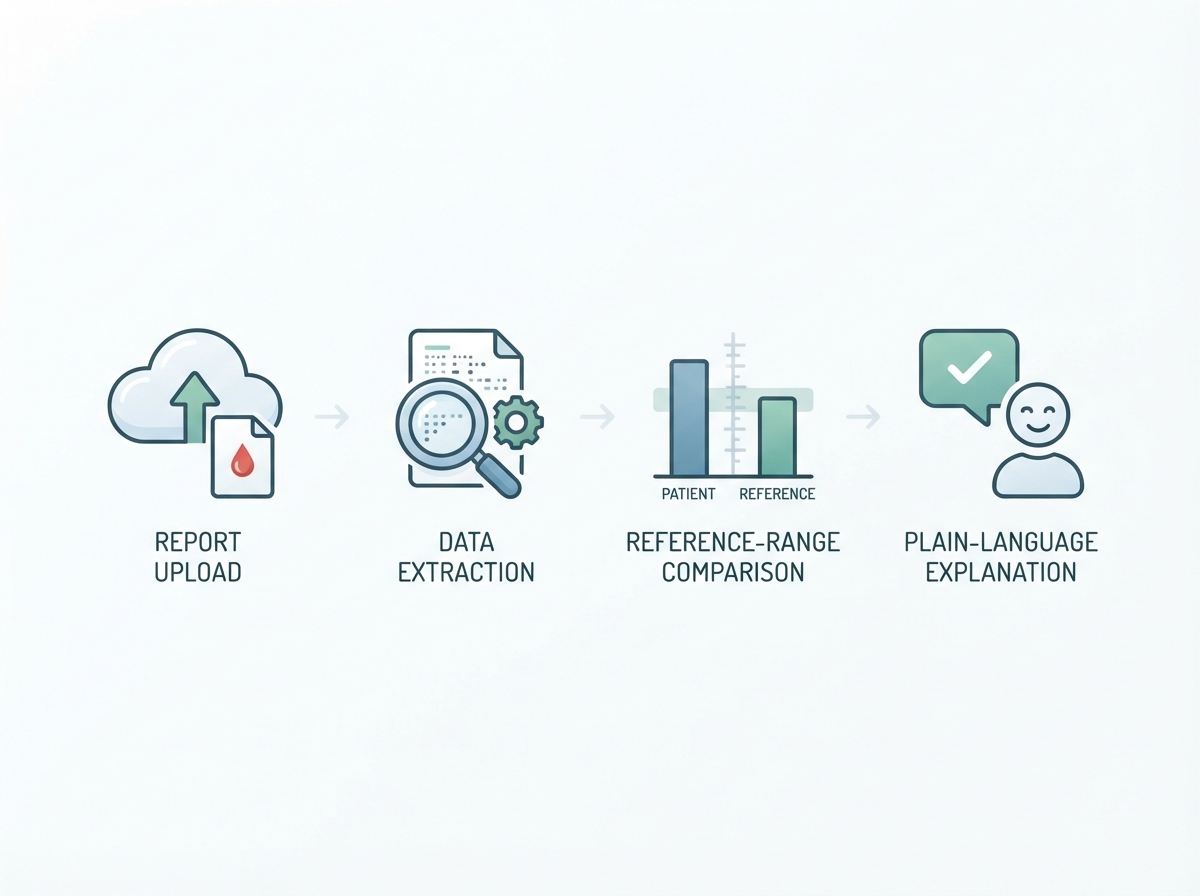
Most tools follow a straightforward process to convert a medical document into an understandable summary. Although features differ between platforms, the general workflow involves four steps.
- Upload the medical report: The user uploads a laboratory report as a PDF or photograph. Some platforms also support scanned documents and images captured using a smartphone.
- Extract the information: The software reads the document and identifies test names, numerical values, units, reference intervals and any existing abnormal-result flags. Optical character recognition may be used when the report is a scanned image.
- Compare values with reference ranges: The extracted results are organised and compared with the reference intervals provided by the laboratory. Values outside those intervals may be highlighted for further attention.
- Generate an explanation: The tool produces a plain-language summary, explains unfamiliar terminology and may suggest questions to discuss with a healthcare professional.
This process enables instant report analysis, although processing speed does not guarantee clinical accuracy. Some platforms also describe their capabilities as AI powered diagnostics, but users should distinguish between educational explanations and software designed or authorised for specific medical functions. These digital health tools vary considerably in their intended use and level of clinical oversight.
What Can an AI Report Analyzer Help You Understand?
An AI report analyzer can help explain several types of medical documents. The depth of interpretation depends on the document quality, supported file formats and capabilities of the platform.
- Blood tests: Complete blood count (CBC), cholesterol panels, blood glucose, thyroid tests, liver function markers and kidney function indicators. These results can help users understand what individual measurements represent and whether they fall within the laboratory's stated ranges.
- Imaging reports: Written radiology findings from X-rays, CT scans, MRIs and ultrasound examinations can be explained in simpler language. However, interpreting the written report is different from independently examining the medical images or confirming a radiological diagnosis.
- Other medical reports: Urine analysis, vitamin levels, electrolyte panels and hospital discharge summaries can contain terminology that patients may find difficult to follow.
- Report language: Users can learn what abbreviations, measurement units, high and low flags and reference intervals mean. They can also understand why a laboratory may identify a value as outside its expected range.
For example, a cholesterol report may show LDL, HDL and triglyceride measurements. An analyzer can explain what each marker represents, but determining an individual's cardiovascular risk requires consideration of additional clinical factors.
Free vs Paid AI Medical Report Analyzers: What's the Difference?
A free AI medical report analyzer can be a useful starting point for patients who need a basic explanation of their results. Paid platforms may offer additional features, but a higher price does not automatically mean better accuracy or medical reliability. When comparing the best AI medical report analyzer options, consider the features that genuinely affect usability, transparency and privacy rather than relying on marketing claims.
| Feature | Free Tools | Paid Tools |
| Cost | Usually free, sometimes with usage limits | Subscription or one-time payment |
| File types | Often support basic PDFs and images | May support additional formats and larger files |
| Explanation depth | Basic summaries and value explanations | May offer more detailed explanations and report comparisons |
| Data privacy | Policies and retention periods vary | Policies and retention periods also vary |
| Human review | Not usually included | May be available as an additional service |
| Best for | Occasional, straightforward report explanations | Frequent use or additional analysis features |
A tool marketed as an AI medical report analyzer online may offer a free upload option while charging for detailed summaries, multiple reports or additional features.
| What to Compare | Questions to Ask |
| Accuracy | Does it explain the source and limitations of its interpretations? |
| Privacy | Does it explain how medical information is stored and used? |
| Report support | Can it read the types of reports you need? |
| Transparency | Does it clearly distinguish explanations from diagnoses? |
| Additional support | Is qualified human review available, and what does it involve? |
Before choosing a platform, read its terms and privacy policy. A free service is not necessarily less secure, and a paid service is not automatically more trustworthy.
Is It Safe to Upload Your Medical Report? Privacy and Accuracy Checklist

Medical reports contain sensitive personal information. Before uploading a document to an AI platform, consider how the service collects, processes, stores and protects your data. Use this checklist before submitting a report:
 Check data retention: Does the platform explain how long uploaded reports and extracted information are retained?
 Understand data usage: Does the privacy policy explain whether your information may be used to train or improve AI models?
 Look for secure medical data upload: Does the service describe encryption and other security measures protecting information during transmission and storage?
 Check deletion options: Can you delete your uploaded report and associated information afterwards?
 Review medical disclaimers: Does the platform clearly state that its explanations are not a substitute for professional medical advice?
 Remove identifying details: Where possible, remove your name, identification number, date of birth and other unnecessary personal information before uploading.
A secure medical platform should provide clear information about its privacy practices rather than relying on general assurances. For additional guidance, the US Department of Health and Human Services explains how HIPAA privacy and security requirements may apply to health applications and the organisations handling health information. Importantly, not every consumer health application is covered by HIPAA. Users should not assume that their information receives HIPAA protection simply because an application handles medical data. Read the HHS guidance on health apps and HIPAA.
Understanding accuracy limitations
AI-generated explanations can contain errors. A poorly scanned document may result in misread numbers, while incorrect units, missing reference ranges or incomplete medical history can affect the interpretation.
For example, a value may appear abnormal because the software has used a different reference interval from the one printed by the laboratory. Similarly, a result that appears normal does not necessarily rule out an underlying health problem.
Always check the original report and confirm clinically important findings with your healthcare professional. The FDA also provides guidance explaining how certain clinical decision-support software functions are evaluated and regulated. Its Clinical Decision Support Software guidance is a useful resource for understanding the distinctions between different types of health software.
How to Use Your Results and When to See a Doctor
An AI-generated summary is most useful when it helps you prepare for a meaningful conversation with your doctor. Instead of treating the explanation as a final answer, use it to organise your observations and identify areas that need clarification. Follow these steps after reviewing your report:
- Write down flagged values: Note which measurements are marked high or low, along with their actual values, units and laboratory reference ranges.
- Record symptoms and medications: Include any symptoms you have experienced, existing health conditions and medicines or supplements you take.
- Keep both documents: Bring the original laboratory report and the AI-generated explanation to your appointment so your doctor can review the information.
- Prepare specific questions: Ask what an abnormal result could mean, whether further testing is needed and how your medical history affects its interpretation.
- Follow professional advice: Do not start, stop or change medication based on an automated explanation.
When should you see a doctor promptly?
Do not wait for an AI explanation if:
- Your report contains a critically abnormal value or a laboratory notification requiring urgent follow-up.
- You experience new, severe or worsening symptoms.
- Your healthcare provider has requested an urgent consultation.
- You are unsure whether a result requires immediate attention.
Seek emergency medical care for severe symptoms such as chest pain, difficulty breathing, fainting or sudden neurological changes. An AI tool should never delay urgent assessment. For patients who want to make their reports easier to understand before an appointment, MySimpleReport can provide a starting point. You can use the MySimpleReport report analyzer to review your results and prepare questions for your next consultation.
Make Your Medical Reports Easier to Understand
Medical reports do not have to remain confusing while you wait for your next appointment. An AI medical report analyzer can explain unfamiliar terminology, organise flagged results and help you prepare relevant questions. However, its explanations should always be considered alongside your symptoms, medical history and professional medical advice.
Understand Your Medical Results with MySimpleReport
Your health information deserves to be understood, not simply stored in a patient portal. Try the MySimpleReport analyzer with your next medical report to explore your results in clearer language and prepare for a more informed conversation with your healthcare provider.